How Many Percent Hindus Eat Beef
Wendy Doniger / The Conversation
Simply this by June, at a national meeting of various Hindu organizations in India, a popular preacher, Sadhvi Saraswati, suggested that those who consumed beef should be publicly hanged. Later on, at the aforementioned conclave, an animal rights activist, Chetan Sharma, said,
"Cow is also the reason for global warming. When she is slaughtered, something called EPW is released, which is directly responsible for global warming. Information technology's what is chosen emotional pain waves."
These provocative remarks come at a fourth dimension when vigilante Hindu groups in Republic of india are lynching people for eating beef. Such killings have increased since Narendra Modi and his right-wing Bharatiya Janata party came to power in September 2014. In September 2015, a 50-year-old Muslim man, Mohammad Akhlaq, was lynched by a mob in a village near New Delhi on suspicion that he had consumed beef . Since and then , many attacks by cow vigilante groups have followed. Modi'due south government has also prohibited the slaughter of buffalo, thus destroying the Muslim-dominated buffalo meat industry and causing widespread economic hardship.
- Not for the Faint of Center: The Aghori and Their Unorthodox Path to Enlightenment
- Aboriginal tablet depicting lewd scene becomes object of veneration in India
- Ritual and Burial: The Strange and Elaborate Ways Humans Prepared Animals for the Afterlife
Virtually people seem to assume that no Hindu has e'er consumed beefiness. Simply is this truthful?
Every bit a scholar, studying Sanskrit and ancient Indian organized religion for over fifty years, I know of many texts that offering a articulate answer to this question.

The ancient Hindu belief holds cows equally symbols of abundance, power, and altruistic giving. ( maestroviejo )
Cows in Ancient Indian History
Scholars take known for centuries that the ancient Indians ate beef. After the fourth century BC, when the practice of vegetarianism spread throughout India among Buddhists, Jains and Hindus, many Hindus continued to eat beef.
In the time of the oldest Hindu sacred text , the Rig Veda (c. 1500 BC), cow meat was consumed . Like most cattle-breeding cultures, the Vedic Indians generally ate the castrated steers, but they would consume the female of the species during rituals or when welcoming a invitee or a person of high status.
Ancient ritual texts known every bit Brahmanas (c. 900 BC) and other texts that taught religious duty (dharma), from the third century BC, say that a bull or cow should be killed to be eaten when a guest arrives.
According to these texts , "the cow is food." Even when 1 passage in the "Shatapatha Brahmana" (3.one.2.21) forbids the eating of either cow or bull, a revered aboriginal Hindu sage named Yajnavalkya immediately contradicts information technology, saying that, nevertheless, he eats the meat of both cow and bull, "every bit long as it's tender."
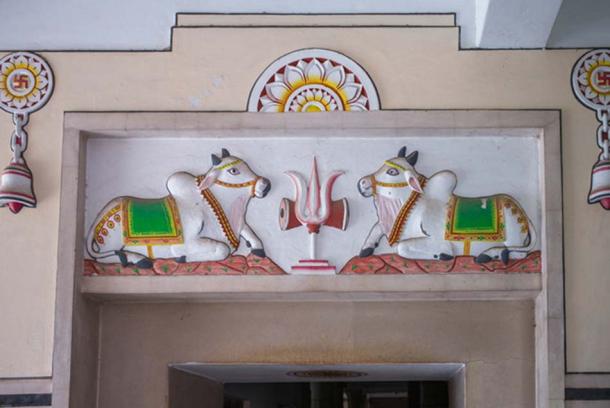
Cows painted over a door are believed to bring adept luck. (Ross Funnell/ CC Past NC ND 2.0 )
It was the Sanskrit epic, the Mahabharata (equanimous between 300 BC and Ad 300) that explained the transition to the non-eating of cows in a famous myth :
"One time, when in that location was a great famine, Male monarch Prithu took up his bow and arrow and pursued the Globe to force her to yield nourishment for his people. The Earth assumed the form of a cow and begged him to spare her life; she then allowed him to milk her for all that the people needed."
This myth imagines a transition from hunting wild cattle to preserving their lives, domesticating them, and breeding them for milk, a transition to agriculture and pastoral life. It visualizes the cow as the paradigmatic animate being that yields food without being killed.
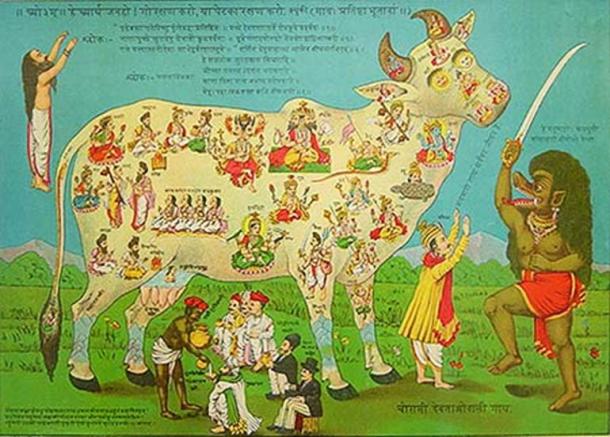
Chaurasi Devataon-wali Gai , or "The Cow with 84 deities" by Raja Ravi Varma. ( Public Domain ) In this affiche condemning the consumption of beef, the sacred cow Kamadhenu is depicted as containing various deities within her body.
Beef-Eating and Caste
Some dharma texts composed in this same period insist that cows should not be eaten. Some Hindus who did eat meat made a special exception and did non eat the meat of cow. Such people may have regarded beef-eating in the lite of what the historian Romila Thapar describes as a "matter of condition" – the college the caste, the greater the food restrictions. Diverse religious sanctions were used to impose prohibition on beef eating, but, equally Thapar demonstrates, "only among the upper castes."
As I meet it, the arguments against eating cows are a combination of a symbolic statement about female person purity and docility (symbolized past the cow who generously gives her milk to her calf), a religious argument well-nigh Brahmin sanctity (equally Brahmins came increasingly to exist identified with cows and to be paid by donations of cows) and a way for castes to rising in social ranking.
Sociologist M. Northward. Srinivas pointed out that the lower castes gave up beefiness when they wanted to motility upward the social ladder through the process known as "Sanskritization."
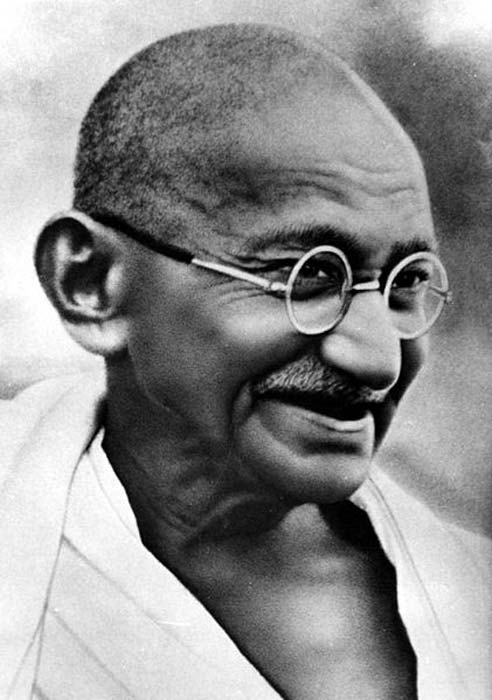
Gandhi. ( Public Domain ) A central tenet of Gandhi's teaching was vegetarianism. Merely he did not telephone call for a beef ban.
By the 19th century, the cow-protection motion had arisen. Ane of the implicit objects of this motility was the oppression of Muslims .
Famously, Gandhi attempted to make vegetarianism, especially the taboo against eating beef, a central tenet of Hinduism. Gandhi's mental attitude to cows was tied to his idea of nonviolence.
He used the image of the Earth cow (the one that King Prithu milked) equally a kind of Mother World, to symbolize his imagined Indian nation. His insistence on moo-cow protection was a major factor in his failure to attract large-calibration Muslim support .
Yet even Gandhi never chosen for the banning of cow slaughter in Republic of india. He said ,
"How can I force anyone not to slaughter cows unless he is himself then disposed? It is non as if there were just Hindus in the Indian Matrimony. At that place are Muslims, Parsis, Christians and other religious groups here."
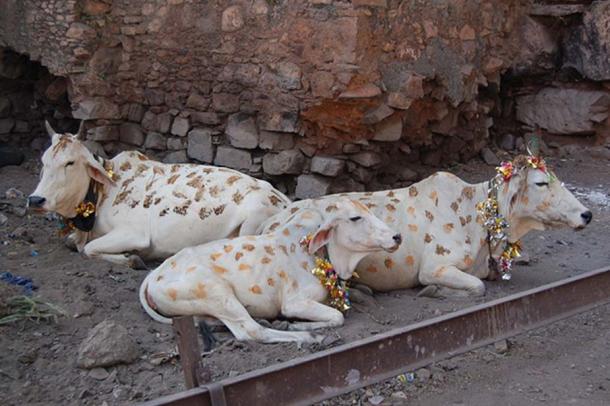
White cows busy for Diwali celebrations. ( CC Past 2.0 )
Today's India
From my perspective, in our twenty-four hour period, the nationalist and fundamentalist "Hindutva" ("Hindu-ness") movement is attempting to use this notion of the sanctity of the cow to disenfranchise Muslims. And information technology is non only the beef-eating Muslims (and Christians) who are the target of Hindutva'south hate brigade. Lower-caste Hindus are also being attacked. Attacks of this blazon are non new. This has been going on since Hindutva began in 1923 . And indeed, in 2002, in a north Indian town, five lower-caste Hindus were lynched for skinning a cow.
- The Past Teaching the Nowadays: Ancient Sanskrit Texts Talk over the Importance of Environmental and Species Conservation
- Kailasa Temple: How Was This Massive Hindu Temple Carved out of a Single Rock?
- The Mythological Origins of Holi: Ancient and Colorful Festival of South Asia
But, as local assay shows, the violence has greatly increased under the Modi government. IndiaSpend, a data journalism initiative, found that "Muslims were the target of 51 per centum of violence centered on bovine issues over nearly eight years (2010 to 2017) and comprised 86 percent of 28 Indians killed in 63 incidents…As many of 97 percentage of these attacks were reported after Prime Government minister Narendra Modi's government came to power in May 2014."
In 2015, in the western Indian state of Gujarat, lower-caste Hindus were flogged for skinning a dead cow, triggering spontaneous street protests and contributing to the resignation of the state's chief minister.
As these and and then many other recent attacks demonstrate, cows – innocent, docile animals – have get in India a lightning rod for human cruelty, in the name of religion.
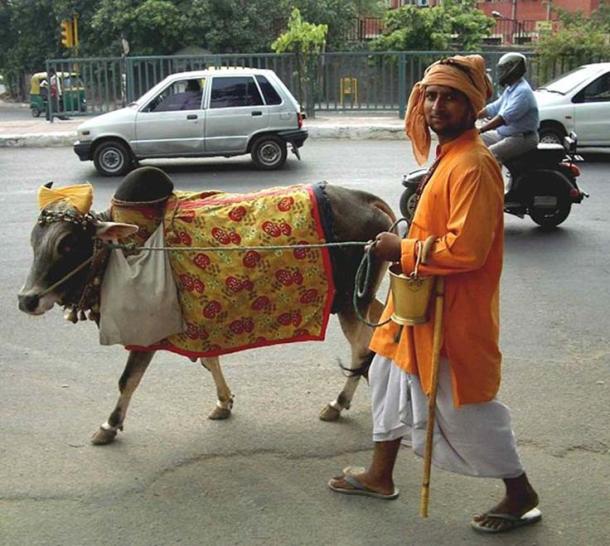
Cow on Delhi street. (John Hill/ CC Past SA iii.0 )
Meridian Image: Sticker showing baby Krishna stealing milk from a moo-cow. Source: counterclockwise/ CC By NC SA 2.0
The article ' Hinduism and its Complicated History with Cows (and People Who Eat Them) ' by Wendy Doniger was originally published on The Conversation and has been republished under a Artistic Eatables license.
Source: https://www.ancient-origins.net/news-general/modern-hindus-forbidden-eating-beef-ancient-hindus-ate-sacred-cow-008504

Postar um comentário for "How Many Percent Hindus Eat Beef"